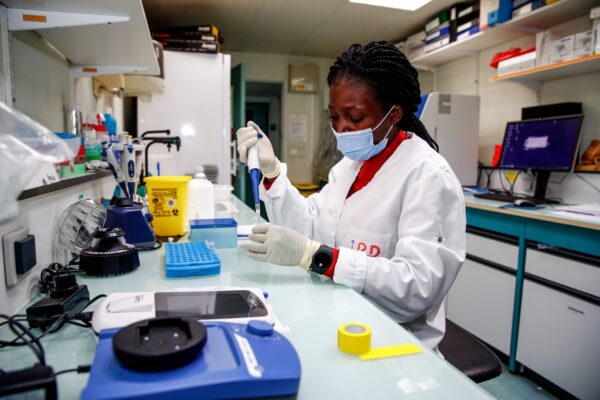
Publication of an article in the Journal of Global Health summarizing the first three years of the AFROSCREEN project on genomics capacity building in Africa.
Publication of an article in the Journal of Global Health summarizing the first three years of the AFROSCREEN project on genomics capacity building in Africa.
Strengthening genomic surveillance in West Africa, Central Africa and the Indian Ocean: key lessons from the AFROSCREEN programme
Launched in 2021, the AFROSCREEN programme, funded by the French Development Agency (AFD) and coordinated by the ANRS Emerging Infectious Diseases (ANRS MIE), the French National Research Institute for Sustainable Development (IRD) and the Pasteur Institute, has been rolled out across 13 countries in West Africa, Central Africa and the Indian Ocean.
The programme has just published a review of its first three years of work on strengthening genomics capacity in Africa in the Journal of Global Health. Over the course of three years, it has enabled the purchase and delivery of next-generation sequencers adapted to local contexts, the training of more than 250 professionals in sequencing and bioinformatics analysis, and the networking of 25 public health and research institutions, all of which are now firmly established at the local level.
One of the key contributions of the AFROSCREEN programme is that it has demonstrated that capacity building in genomic surveillance is not merely a technical challenge. It is also a fundamental issue of health equity. Prior to this project, many African countries relied heavily on laboratories located abroad to carry out genomic sequencing. This dependence led to significant delays, limited access to data and reduced their usefulness for rapid public health decision-making.
By enabling the development of sequencing capabilities directly within participating countries, the AFROSCREEN programme has helped to reduce this dependence. National laboratories have thus been able to analyse samples of the SARS-CoV-2 virus and other emerging pathogens with epidemic potential locally. This advance has helped to fill critical gaps in surveillance, whilst making genomic data more accessible and directly usable, within a useful timeframe, by local health authorities.
However, the programme has also highlighted that technical capacity-building alone is not sufficient to resolve structural inequalities. Several persistent obstacles have been identified. Among these, difficulties related to the supply of equipment and reagents represent a major hindrance. Procurement procedures are often lengthy, complex and ill-suited to the urgency of health emergencies. These delays can compromise laboratories’ ability to operate optimally and continuously.
Another challenge concerns data governance. In some contexts, issues of ownership and sharing of genomic data remain unclear or insufficiently regulated. This can limit regional collaboration between institutions and hinder the optimal use of the information collected. Added to this is a chronic problem of underfunding. Genomic surveillance initiatives often rely on external and ad hoc funding, which raises questions about their sustainability.
The human factor is also a key challenge. A lack of sufficiently qualified staff, combined with high staff turnover, undermines the project’s achievements. Training experts in genomics and bioinformatics analysis requires significant time and resources. However, without stable and attractive career prospects, these newly trained professionals are often forced to leave the public sector or seek opportunities abroad.
Finally, one of the major challenges lies in translating genomic data into concrete public health actions. Generating data is one thing, but integrating it into decision-making processes is quite another. This requires clear and effective communication mechanisms between scientists and policy-makers, as well as the ability to interpret results within an operational context.
In light of these findings, the AFROSCREEN consortium proposes an approach structured around five interdependent levers, which must be developed simultaneously to ensure a lasting impact.
The first lever concerns the simplification of procurement frameworks. It is essential to put in place more flexible and responsive mechanisms for the purchase of scientific equipment. This could involve regional agreements, fast-track procedures or partnerships with local suppliers.
The second lever focuses on the development of ready-to-use bioinformatics pipelines. Analysing genomic data requires complex tools, which are often difficult to master without advanced expertise. Providing standardised, accessible solutions tailored to local contexts would make them easier to use and improve the quality of the analyses.
The third lever aims to ensure sustainable funding, integrated into national budgets. Genomic surveillance cannot depend solely on international funding. It must be recognised as an essential component of health systems and receive stable, long-term financial support.
The fourth lever concerns strengthening institutional links between laboratories and health ministries. Close collaboration is essential to ensure that the data produced is effectively used in decision-making. This involves establishing formal frameworks for coordination and communication.
Finally, the fifth lever focuses on stabilising career pathways. It is crucial to create attractive career opportunities for scientists and specialist technicians in order to retain talent and strengthen national capacity.
In conclusion, to build effective and equitable surveillance systems, it is necessary to adopt a comprehensive approach, integrating technical, human and political dimensions. By addressing these three areas, the aim is to ensure that the next epidemic alert is detected, sequenced and interpreted by the member institutions of the AFROSCREEN network, which will then be able to inform their respective health authorities with evidence-based data.